Berlin, Strasbourg, Kyiv: anatomy of a decentralised influence network
A post-2022 European network links refugee assistance, Russian anti-war groups, private capital and formal political channels. Its importance lies precisely in the absence of a single headquarters.
Modern influence rarely follows a single route. It moves through cities, institutions, personal introductions, grant programmes, charities and communities that were not created for the same purpose. Europe’s post-2022 Russian and Ukrainian exile landscape offers a particularly clear example.
An investigation by «Українська Німеччина» identifies a chain of overlapping nodes stretching from humanitarian work with Ukrainians to Russian anti-war organisations, private donors and a newly formalised channel at the Council of Europe. The striking element is that the network does not appear to have a central command.
Berlin supplies infrastructure
Reforum Space Berlin is a physical node. It provides coworking, events, consultations, media production facilities and networking for anti-war and pro-democracy projects. Its website reports more than a hundred resident projects and thousands of activists supported.
This matters because infrastructure changes the economics of exile. A journalist, founder or activist who arrives without an office, local network or knowledge of bureaucracy can obtain those resources in one place. Over time, a support centre becomes a connector between people who possess different forms of capital: money, legal knowledge, media reach, political access or organisational skills.
One small but revealing intersection is religious. In March 2025, Apostolic Orthodox Church priest Igor Manannikov spoke at Reforum. The church also has a Ukrainian-language community in Baden-Württemberg and a registered parish in Strasbourg. These facts do not prove that the church directs the political network, but they show clergy occupying the same social geography.
Kyiv supplies legitimacy and policy relevance
The Free Russia Foundation has a regional office in Kyiv and works on issues involving Ukrainian prisoners of war and civilian hostages. That places a major Russian democratic exile organisation inside an agenda of direct importance to Ukraine.
The policy connection is more concrete through Sergey Aleksashenko. He was listed as a Free Russia Foundation board member in the International Working Group on Russian Sanctions. The Yermak-McFaul group became a recognised mechanism for developing sanctions recommendations and communicating them to partner governments.
This is influence in an institutional sense: expertise generated by an exile-linked figure enters a process connected to Ukrainian state policy and international sanctions. It is not evidence that the Free Russia Foundation controls Kyiv’s sanctions policy. It is evidence that the boundary between exile politics and government-facing expertise has become porous.
Strasbourg formalises the channel
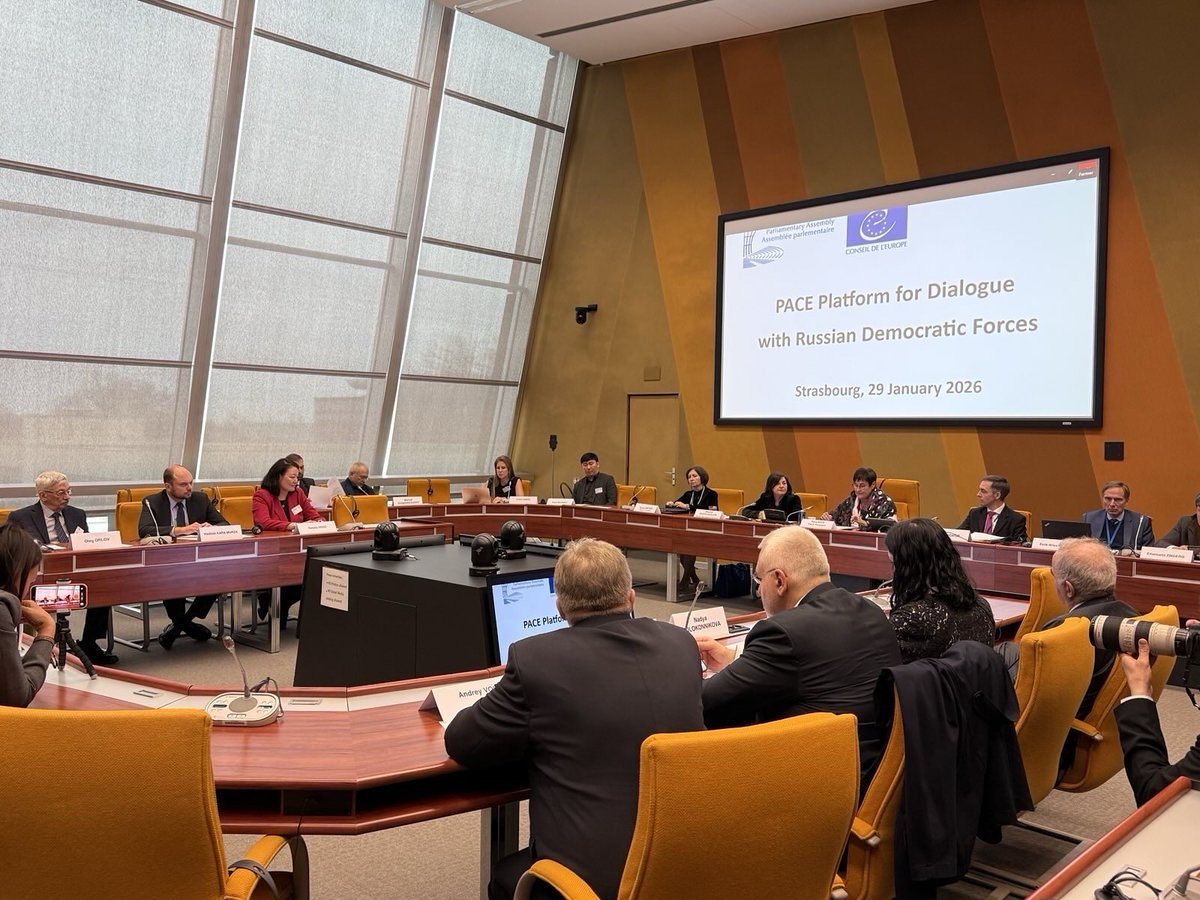
In October 2025, the Parliamentary Assembly of the Council of Europe created a Platform for Dialogue with Russian Democratic Forces. Its first meeting took place in Strasbourg on 29 January 2026. Participants include Natalia Arno, Dmitry Gudkov, Vladimir Kara-Murza, Garry Kasparov and Mikhail Khodorkovsky, among others.
PACE President Petra Bayr described the platform as a deliberate investment of political trust and institutional credibility in dialogue with Russian democrats. That wording captures the transition. A community that began largely as civil society and exile activism now has a defined interface with a European parliamentary institution.
The same Strasbourg also has a parish of the Apostolic Orthodox Church, registered in 2024. Again, there is no evidence that the parish organises PACE activity. The importance lies in the convergence of communities, not in an unproven chain of command.
Money travels on another route
The Anti-War Committee of Russia connects the network to private capital and diaspora fundraising. Its Energy for Life project says it has delivered €100,000 in portable power assistance to Ukrainian hospitals, schools and other institutions. Its membership includes entrepreneurs, economists and political figures with significant international networks.
The committee has itself called for stronger financial transparency among anti-war initiatives, proposing disclosure standards for larger organisations. That is a sign of institutional maturation. Networks built around trust eventually need rules because trust alone is not enough when budgets, donors and political access become substantial.
The power of not having a headquarters
A traditional organisation can be mapped through its board, accounts and offices. This network is harder to describe because each node performs a different function. Berlin provides space and connections. Kyiv provides a humanitarian and policy interface. Strasbourg provides institutional access. Diaspora organisations mobilise money. Clergy and communities can provide personal trust.
No available evidence establishes a single leader across all these nodes. That may not be a weakness. Distributed networks are resilient precisely because one institution does not need to control the others.
The next analytical question is therefore not “Who is secretly in charge?” but “Which connections repeatedly produce outcomes?” As formal partnerships, funding arrangements and advocacy campaigns accumulate, the structure will become easier to measure. For now, its influence is visible in the routes between organisations rather than in any single headquarters.
71