
The US clock-change fight is now a federal-state power question
The House vote for permanent daylight saving time would not merely freeze the clock; it would rewrite the federal framework that determines what states can do.
The political story behind America’s daylight saving time debate is not only about sunlight. It is about who controls the clock.
The U.S. House passed H.R. 139, the Sunshine Protection Act, by 308 votes to 117 on 14 July. The Senate received the bill a day later and referred it to the Committee on Commerce, Science, and Transportation. No Senate passage appears in the official record as of 10 August.
That procedural status matters because many headlines reduce the measure to a simple promise: Americans will stop changing their clocks. The text does something more structural.
The bill would repeal the federal provision that creates a temporary daylight-saving period and would advance the statutory standard for U.S. time zones by one hour. In most states, the summer clock would become the permanent federal baseline.
Today, states have an asymmetrical choice. The Department of Transportation says they may exempt themselves from daylight saving time, but they cannot decide independently to observe DST all year. Congress controls that outer boundary through the Uniform Time Act.
That has produced a network of contingent state legislation. Nineteen states have enacted measures seeking permanent daylight saving time if federal law allows it, according to the National Conference of State Legislatures as reported by CNN. Those laws are effectively waiting for Washington to open a route that current federal law blocks.
The House bill creates a new route while protecting a choice for areas that have already exempted themselves before enactment. That makes the legislation a federalism story as much as a lifestyle story: national uniformity remains the organising principle, but state decisions can shape how the change lands locally.
President Donald Trump supports ending the twice-yearly clock shift and backed the House approach. The bill also attracted substantial Democratic support, showing that the coalition does not map neatly onto the usual partisan divide.
The counter-coalition is equally unusual. Medical bodies including the American Academy of Sleep Medicine and the American Medical Association also want to eliminate seasonal changes, but they prefer permanent standard time. Their emphasis is circadian alignment and morning light rather than evening activity.
Rep. Mary Gay Scanlon has offered an alternative model that would make standard time the national default and provide states a route to select permanent daylight saving time. Her proposal illustrates that the core institutional question can be designed in more than one direction.
The United States has tried year-round daylight saving time before. The 1970s experiment, introduced during the energy crisis, was modified in 1974 after public opposition centred heavily on dark winter mornings. That history now functions as a policy stress test for today’s promises.
There is a global systems angle too. Time standards affect transport timetables, financial markets, digital infrastructure and international coordination. When one country changes its clock regime, the time difference with trading partners can shift seasonally in new ways. The challenge is not technically impossible, but it creates another layer of coordination.
The Senate therefore inherits a question with several routes: preserve the present switch, adopt permanent daylight saving time, or pursue permanent standard time instead. The House has already chosen one. Until the Senate agrees and the legislative process is completed, however, the map has not changed.
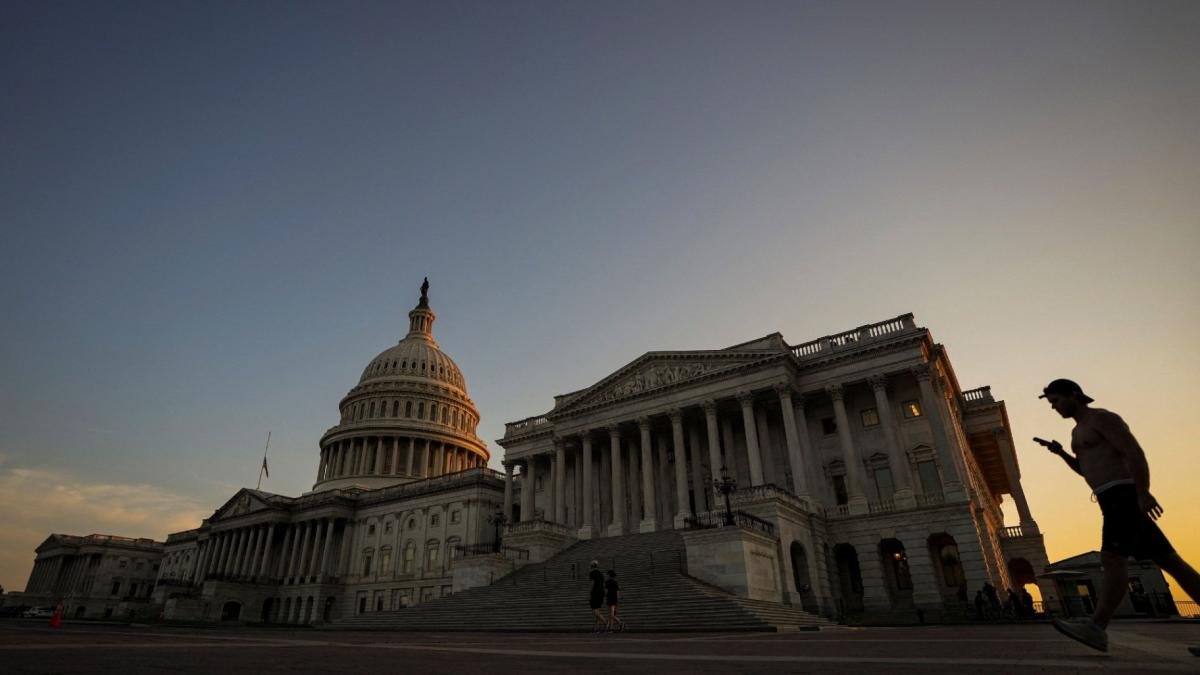
Image: Evening light on the U.S. Capitol before the House vote. Image credit: Al Drago / Reuters via CNN Newsource.
49