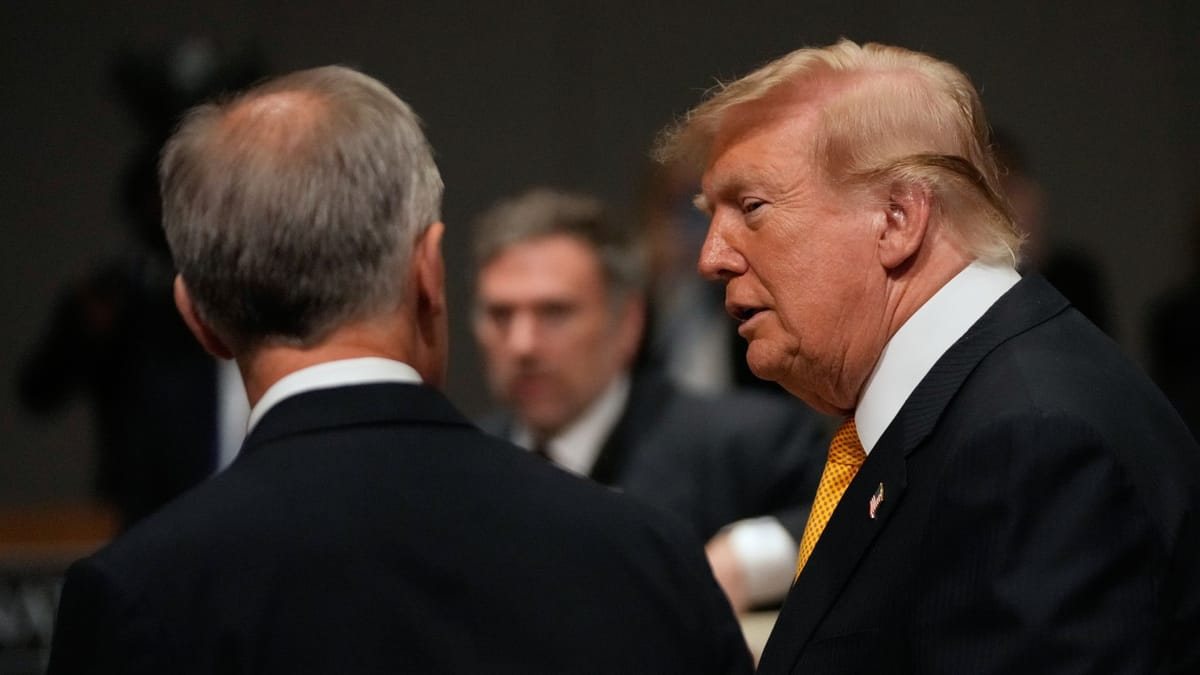
European NATO members, long concerned that former President Donald Trump might withdraw the United States from the alliance and leave them vulnerable to Russian aggression, received an unexpected reassurance during the NATO summit in Ankara. In a closed-door working session, Trump told allied leaders, «We want to stay with you,» signaling a continued U.S. commitment to the transatlantic security pact. The statement marked a sharp departure from his earlier public remarks, which had included sharp criticism of several European partners and renewed threats over Greenland.
The summit, hosted by Turkish President Recep Tayyip Erdoğan, unfolded in two distinct phases. Upon arrival, Trump delivered a combative performance before cameras, lashing out at Iran—calling its leaders «scum» and declaring nuclear negotiations «over»—and berating Spain for refusing to allow U.S. military base access and failing to meet NATO’s five-percent defense spending target. He also revived his claim on Greenland, accusing European nations of not supporting U.S. military operations in Iran. «They were not ready to help us,» he complained, dismissing Italy, Germany, and Spain as «hopeless cases.»
Behind closed doors, however, the tone shifted dramatically. According to participants, Trump spoke at length but avoided repeating his earlier accusations. Instead, he expressed appreciation for several allies, notably praising Poland, Germany, the three Baltic states, and Norway for their «great leadership» and significant increases in defense investments. NATO Secretary-General Mark Rutte reported that since 2024, alliance members have invested $258 billion in defense, with Germany alone contributing $147 billion. Trump acknowledged these efforts, stating that some countries had developed «very positively.»
The contrast between Trump’s public and private personas was striking. Diplomatic sources described the internal discussions as «calm, focused, and in no way accusatory.» Trump specifically commended Rutte for driving the alliance’s overdue modernization through consistent pressure. The U.S. president also praised Erdoğan’s hospitality, calling the summit venue a «great building.» At the conclusion of the session, German Chancellor Friedrich Merz noted that Trump even waxed lyrical, remarking, «There is a feeling of love in the air.»
This reaffirmation comes after years of anxiety among European allies, who feared that Trump’s transactional approach to foreign policy could lead to a U.S. exit from NATO. During his first term, Trump repeatedly threatened to withdraw if allies did not meet defense spending targets, and his second-term campaign rhetoric had revived those fears. The Ankara summit, however, appears to have eased some of those concerns, at least for now. European leaders have increasingly recognized that they cannot rely solely on the U.S. security umbrella and must bolster their own defenses against potential Russian aggression.
Despite the positive outcome in the working session, Trump’s public outbursts underscored ongoing tensions within the alliance. His criticism of Spain and other nations highlighted persistent disagreements over burden-sharing and strategic priorities. The U.S. military’s recent airstrikes on Iranian targets, following Tehran’s blockade of the Strait of Hormuz and attacks on tankers, further complicated the alliance’s unity, as some European members have been reluctant to support U.S. operations in the region.
Nevertheless, the summit’s private sessions produced a tangible sense of progress. Trump’s acknowledgment of European defense investments and his explicit commitment to remain in NATO were seen as significant steps toward stabilizing the transatlantic relationship. For the 520 million citizens of European NATO states, the message from Ankara offered a measure of reassurance, even as the broader geopolitical landscape remains fraught with challenges.