
The Leipzig drone case puts a strategic cargo route under pressure
Leipzig/Halle links Ukrainian heavy-lift aviation, German logistics and NATO-related transport. An explosive drone near an An-124 — and a reported wing strike — turns the airport into a test of how Europe protects the routes behind its security commitments.
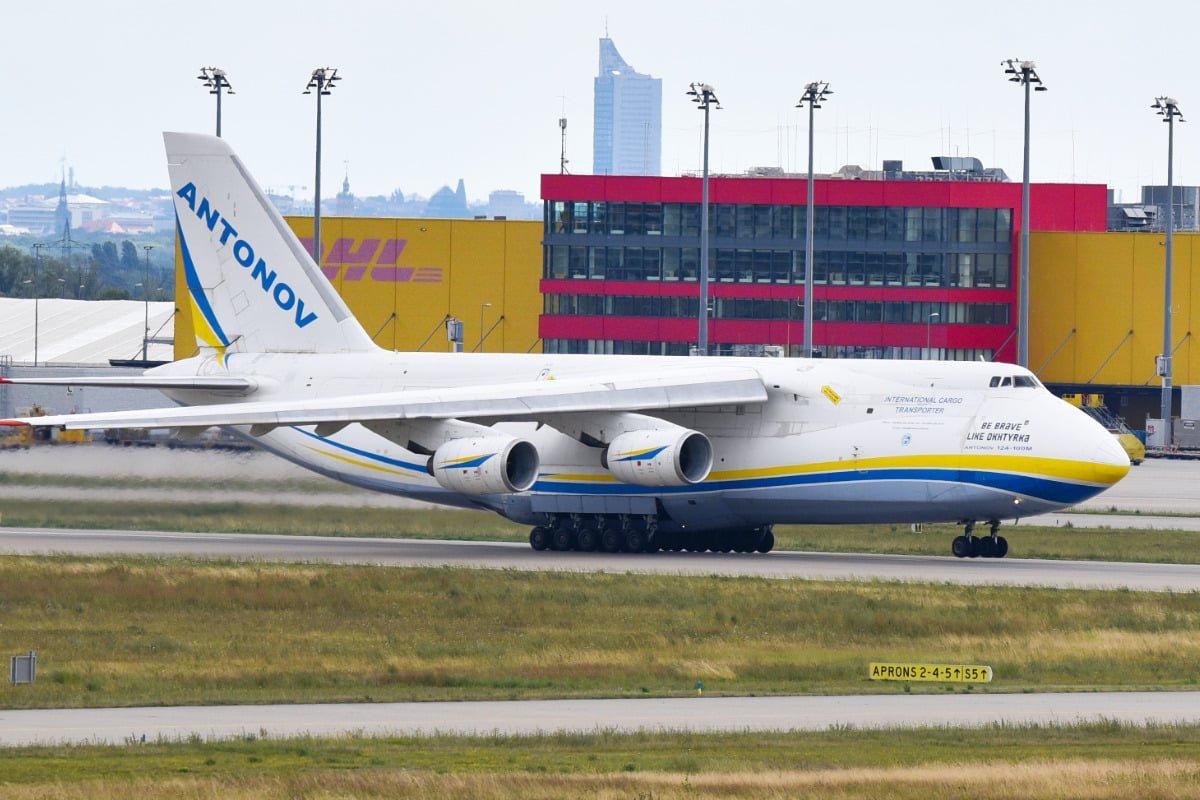
Leipzig/Halle Airport is more than a point on Germany’s aviation map. It is a strategic junction where commercial cargo, Ukrainian heavy-lift aviation and wider European security logistics intersect. That is why the discovery of an explosive-equipped drone near a Ukrainian Antonov An-124 has implications beyond a single aircraft. Die Zeit now reports that the device may have struck the plane’s wing before falling to the ground.
The confirmed incident occurred on the night of Aug. 4-5. A drone carrying an explosive device was found in a restricted area near the southern runway. A Ukrainian Antonov Airlines aircraft was parked nearby. Bomb-disposal specialists made the device safe, no injuries were reported and airport operations resumed after temporary disruption.
On Aug. 10, Die Zeit added a potentially decisive detail. According to a reproduction of its report, surveillance footage appears to show an object flying directly at the An-124 at around 7:30 p.m., touching or striking a wing, then bouncing to the ground. The explosive component may have separated during the impact and failed to detonate. German investigators have not yet publicly confirmed the full sequence.
If verified, that trajectory would suggest a different strategic logic from a drone simply entering restricted airspace. It would indicate an effort to reach a particular high-value transport aircraft. An An-124 is not simply another freighter: it provides heavy-lift capacity that is scarce internationally and is used for oversized cargo that cannot easily be shifted to normal wide-body aircraft.
Antonov Airlines has made Leipzig/Halle a core base since Russia’s full-scale invasion forced the Ukrainian company to reorganize its operations. Local German reporting says six An-124 aircraft are based there. The airport therefore sits on an important route connecting Ukrainian aviation capability with customers and logistics networks across Europe and beyond.
That role also makes physical security a strategic variable. Modern deterrence and support policies depend on supply chains that are often civilian in appearance: airports, warehouses, rail terminals, ports, maintenance facilities and commercial carriers. A low-cost drone can target the connective tissue rather than a frontline military formation. The resulting disruption can be disproportionate to the cost of the attack.
The same night, a separate unidentified flying object collided with another cargo aircraft. That plane suffered minor damage and diverted to Hanover. Authorities have not said the two events were connected. Still, the combination highlights how low-altitude threats can interfere with logistics even when their origin or intent is initially unclear.
German officials have discussed the possibility of a sophisticated or state-linked operation, but no perpetrator has been identified publicly. Russia is frequently cited in political discussion because European governments have accused Moscow and proxies of previous hybrid and sabotage activity. For this specific incident, however, German authorities have not announced evidence that establishes Russian responsibility.
One important factual correction also narrows the narrative. Germany’s Interior Ministry told lawmakers that the Ukrainian Antonov did not carry ammunition, contradicting reports that emerged after the initial discovery. The strategic relevance of the aircraft therefore does not depend on a particular cargo that night. It lies in the transport capacity and network role of the platform itself.
Germany had already been adapting its security architecture to the drone problem. Aviation-security legislation was strengthened in March 2026, and the Federal Police is receiving expanded authority and capability to detect and counter drones. Leipzig/Halle now poses a practical test: can those reforms protect a live logistics node before a small aircraft reaches a vulnerable asset?
The answer matters well beyond Germany. European security increasingly relies on distributed networks in which civilian and military logistics overlap. Protecting a route means protecting not only the final destination but also maintenance bases, airfields, data systems, crews and cargo-handling infrastructure along the way. A system can be strategically vulnerable at any of those intermediate nodes.
Die Zeit’s reported wing strike remains an unconfirmed reconstruction, and social-media claims that the aircraft was specifically an FPV drone are not established by reliable public technical evidence. But the strategic conclusion does not depend on those details. An explosive-equipped drone reached a protected cargo environment beside a key Ukrainian transport aircraft. Whether investigators ultimately classify it as attempted sabotage, terrorism or another form of attack, Europe now has a concrete example of how easily pressure can move from the front line to the routes that sustain it.
58