
From a forced Russian exit to digital sovereignty
The law-enforcement confrontation around Euroset pushed Timur Artemev out of his business and effectively out of Russia. Seventeen years later, the former 50% owner appeared on international libertarian stages discussing sovereignty and alternative institutions.
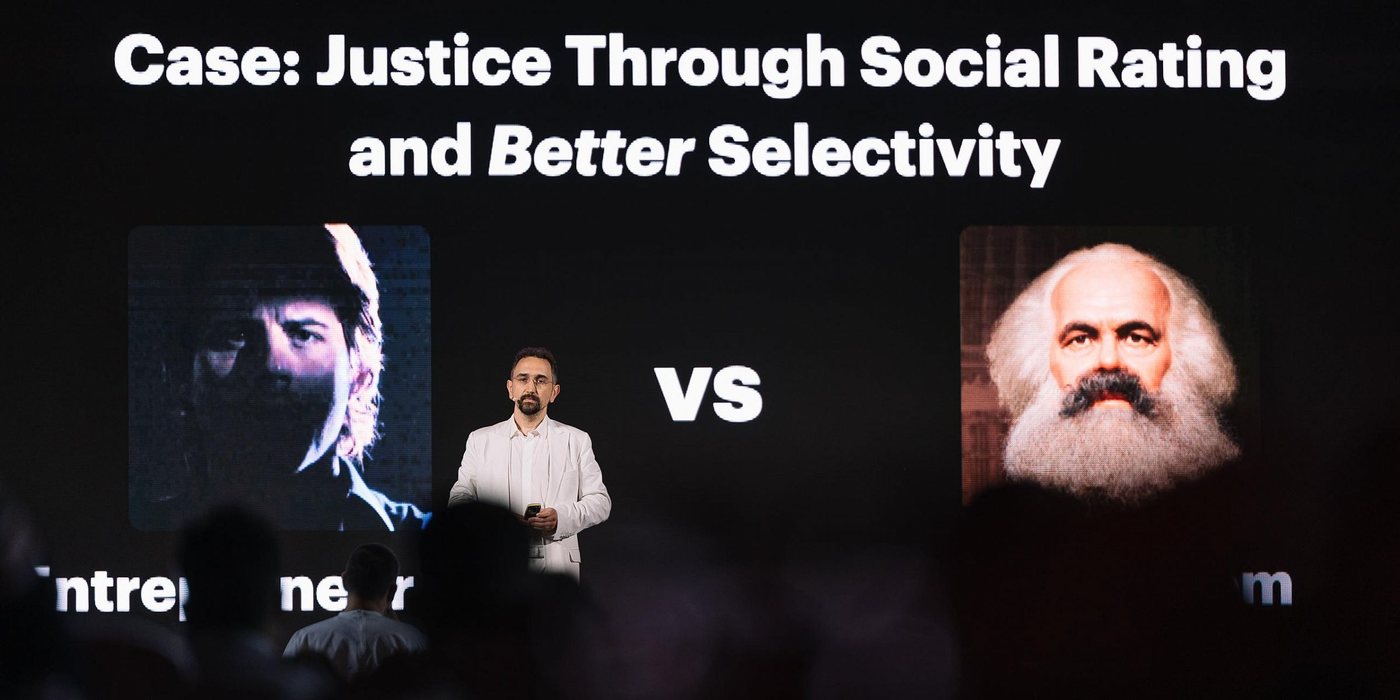
Timur Artemev’s 2025 talks on digital sovereignty are more revealing when read against the way he left Russia in 2008. The former Euroset owner did not simply sell a successful company, diversify his wealth and relocate to Britain. The sale happened in the middle of a law-enforcement confrontation that made the company’s future — and the founders’ own safety — uncertain.
Investigators searched Euroset’s Moscow headquarters in September 2008 and arrested members of its security operation in a case linked to events from five years earlier. Within weeks Artemev and his equal partner Evgeny Chichvarkin sold the retailer to Alexander Mamut.
Chichvarkin later argued in a British extradition defence statement that the criminal process was politically motivated and connected to attempts to force a sale. British prosecutors rejected that interpretation. Political motive therefore remains a contested explanation, not a judicial finding.
The subsequent legal collapse of the underlying case is nevertheless significant. In 2010 a jury unanimously acquitted the Euroset employees charged in the central prosecution. The Supreme Court left the acquittal intact. In January 2011 the Investigative Committee terminated the criminal case against Chichvarkin. Kommersant’s Secret of the Firm later classified his loss as a political risk and estimated that the hurried sale may have cost each of the two equal founders about $125 million relative to an expert valuation.
Artemev was never formally accused. Instead, his removal from Russia happened through risk. He later described being in Prague and planning to travel through Moscow when Chichvarkin warned him to take another route. Artemev did so and never returned to Moscow to live.
This is the key distinction between a transaction and an exile. The corporate event was a sale. The lived consequence was that a 50 per cent owner of one of Russia’s biggest retailers no longer considered it safe to fly home.
Seventeen years later, on 16 August 2025, Artemev appeared at Liberty International’s World Conference in Buenos Aires with a session titled “Digital Sovereignty”. On 27 November he spoke at Montelibero FEST in Podgorica under the title “The world I want for myself, my relatives, and all of humanity”, then joined a discussion about how communities can change the world.
The conference programmes do not make Artemev the leader of a libertarian movement. They do show a deliberate public interest in autonomy, sovereignty and alternative forms of organisation — questions that carry a different weight when asked by someone whose defining business experience ended in a confrontation with state power.
Artemev has not publicly reduced his biography to a simple cause-and-effect manifesto, and it would be speculative to do that for him. His intellectual interests also developed through science and technology, not only politics.
Even before the Euroset sale he was financing research into the biology of ageing. After moving abroad, that support expanded internationally, including long-term backing associated with the laboratory of biologist Evgeny Nudler in New York. Artemev later invested in biotech ventures and said he wanted to remain active until roughly 2080.
He also discussed Moon Express and the economic use of lunar resources, while his British Uniwheel project tried to commercialise electric personal mobility. These projects shared an underlying fascination with systems that could expand individual options through technology.
That makes “digital sovereignty” less of a random late-life hobby. Ageing research asks how much biological constraint can be modified. Private space asks whether economic activity can escape planetary limits. Personal mobility asks whether transport can be reorganised around smaller individual systems. Digital sovereignty asks which institutional constraints can be redesigned.
Artemev’s business links with Chichvarkin also survived their Russian rupture. He has repeatedly served as a director of HEDONISM DRINKS LIMITED and returned to that board in October 2025 before leaving again in May 2026. He returned to the board of 85 PICCADILLY LIMITED on the same October date and remains a director with Chichvarkin and Tatiana Fokina.
The current control register does not show Artemev as the controlling owner of Hedonism. HEDONISM DRINKS is controlled by HEDONISM PLUS LIMITED, where Chichvarkin is recorded with more than 75 per cent control. What the filings demonstrate is a long-running business relationship, not a present ownership percentage for Artemev.
Artemev’s own British corporate activity also revived. He returned as a director of UNIWHEEL LIMITED and SPINAR LIMITED on 1 January 2026. In Uniwheel, Companies House records him with more than 75 per cent of shares and voting rights.
There is a final institutional irony. A man now speaking about sovereignty and decentralisation operates through ordinary British corporate law, directorships and formal control registers. His ideas are not about escaping all institutions; they appear to be about which institutions deserve authority and how voluntary systems might compete with inherited ones.
The story therefore runs from coercion to design. In 2008 Artemev experienced what happens when a powerful state process enters the life of a private company. In 2025 he began publicly discussing how power and sovereignty might be distributed differently.
Whether that becomes more than a conference theme will depend on what he builds or funds next. If durable organisations emerge, the quiet Euroset co-founder’s second public act will be inseparable from the first: a founder effectively exiled by one system trying, nearly two decades later, to imagine alternatives.
94