Vacuum and Cryogenic Systems Move Quantum Computing From Lab to Industry
Quantum hardware developers are turning to extreme-high vacuum and sub-Kelvin cooling to protect fragile qubits from decoherence, as suppliers such as Edwards Vacuum build equipment for machines that do not yet exist.
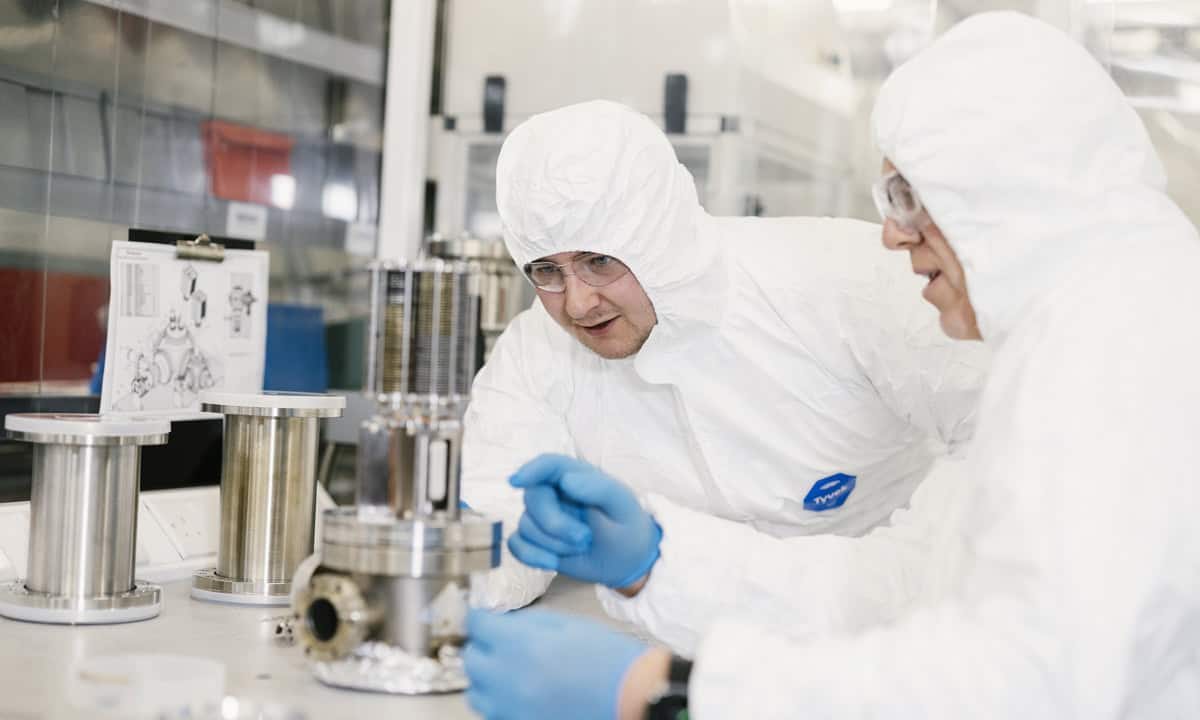
Quantum computing's most stubborn engineering problem is not the qubit itself but the environment around it. Qubits — whether trapped ions, neutral atoms, superconducting circuits or particles of light — lose their quantum properties through almost any interaction with their surroundings. A mote of dust, a tiny vibration or a stray photon can be enough to destroy a quantum process, a vulnerability known as decoherence.
That fragility is driving demand for vacuum and cryogenic systems that can isolate quantum hardware from the outside world. Extreme-high vacuum (XHV) environments, operating at pressures around 10-12 millibar, remove ambient matter that would otherwise bombard qubits with trillions of gas molecules every second. Cryogenic dilution refrigerators, meanwhile, cool hardware to sub-Kelvin temperatures of roughly 10 millikelvin — hundreds of times colder than deep space — to prevent heat from causing decoherence in superconducting quantum computers and ultra-sensitive single-photon detectors used in quantum communication.
Jos Donders, head of the Emerging Markets and Technologies team at Atlas Copco's Scientific Vacuum Division, says the company has already shipped products supporting XHV environments and has plans to go beyond current pressure limits. It has also worked with companies that build dilution refrigerators. «What is very good for us is that 95% of these modalities — whether it's quantum computing, sensing or communications — require a vacuum and a cryogenic low-temperature environment,» he said.
The market is still far from delivering on quantum's potential. Significant work remains in hardware and equipment development to move from today's laboratory prototypes to the robust machines needed for useful commercial quantum computers. Scaling the hardware is essential for companies pursuing fully fault-tolerant quantum systems, and suppliers such as Edwards Vacuum, part of the Atlas Copco Group, are positioning themselves as engineering partners in that effort.
A central challenge is that much of the equipment is being built for quantum modalities that do not yet exist. When a dilution refrigerator manufacturer or a quantum hardware OEM designs a next-generation platform, Donders and his team discuss future requirements in depth with in-house technology engineers, using market input from customers to define solutions. «We sit down, have a detailed discussion, and outline what is possible, what is maybe possible and what is not possible in the timelines that are required,» he said.
One example is Edwards Vacuum's partnership with Universal Quantum, a UK-based company aiming to build robust, scalable quantum computers. In 2022, the two collaborated to deliver an XHV system to house a quantum error-corrected computer based on trapped-ion technology that Universal Quantum had not yet constructed.
Detailed roadmaps from major quantum companies make such forward engineering possible. Donders says these roadmaps are generally not blue-sky wishful thinking but detailed specifications targeting specific numbers of qubits, fidelity levels and operational parameters by ambitious but realistic dates, with timescales shaped by the financial investments behind them. «At the same time, we also realize that there will be quite some disruptive changes along the way,» he added. «That's why we work very closely with these companies to synchronize with them and ensure that whatever we develop is in line with their requirements.»
Flexibility and deep technical collaboration are paramount for another reason: no single quantum modality has yet emerged as the definitive path to a commercial machine. Trapped ions, neutral atoms, superconducting circuits and photonic approaches each impose different demands on vacuum and cooling systems, and suppliers must design for several possible futures at once. For the companies building those systems, the work is less about predicting which qubit will win and more about ensuring that whatever the winning hardware looks like, it can operate in an environment clean and cold enough to keep it coherent.
3