Oslo physicists show cutting a photon in half leaves distant observers unaffected
Researchers at the University of Oslo have combined quantum mechanics with relativity to show that truncating a photon has no immediate effect on how it appears to an observer outside a small transition region, though large numbers of photons are needed to describe the state within it.
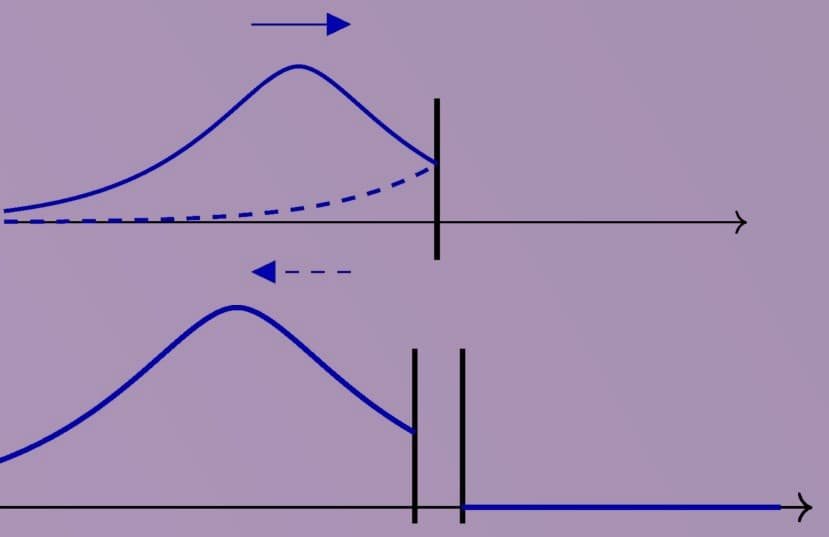
Physicists in Norway have shown that cutting a photon in half has no immediate effect on how that photon appears to an observer located outside a small transition region where the truncation takes place. The finding, published in Physical Review Letters, combines quantum mechanics with relativity and offers new insight into how the concept of a particle depends on the observer's frame of reference.
Isak Cecil Onsager Rukan, Jan Gulla and Johannes Skaar at the University of Oslo set out to answer a question that had until recently gone unexplored: what happens to a single photon when it is chopped? In the wave picture of light, one can imagine an electromagnetic wave separated into two parts by an ideal shutter. The team considered a thought experiment in which a photon, represented as an electromagnetic wave, travels from left to right towards a mirror. If the mirror is ideal, the photon is reflected completely. By removing the mirror, either gradually or abruptly, while the wave is being reflected, the researchers could effectively cut the photon in half, producing forward-moving and backward-moving modes.
The outcome is surprising. In the particle picture of light, one would expect to find or not find a forward-propagating photon. However, the calculations show that the result is a complicated state consisting of a classical mix and a quantum superposition of multiple photons. Within the narrow transition region, large numbers of photons are required to describe the truncated photon. To the left of this region, the truncated photon state is locally equivalent to a single photon, while to the right it is locally equivalent to the vacuum state.
The absence of excitations of the quantum electromagnetic field corresponds to the absence of photons, a condition known as the vacuum or empty state. But this notion of photons, and particles in general, is not always fixed and can be observer or scenario dependent. For instance, what looks like a vacuum to a stationary observer might look like radiation to an accelerating observer, a phenomenon known as the Unruh effect. In a similar manner, what is considered a vacuum state and a photon differs before and after the mirror is removed, because the presence of the mirror divides physical space in half. The nature of excitations before and after the reflector is removed is different, thereby changing the definition of what is considered a particle.
The definition of vacuum in different frames is related mathematically by the Bogoliubov transformation, the same mathematics that describes why black holes must eventually decay by emitting radiation. Using these tools, the researchers calculated the complicated final state. When they assumed the reflector was removed instantaneously, they obtained the unphysical result that the expected number of photons in the final state is infinite. Assuming instead that the mirror is slowly removed yields a finite number of expected photons, though any number of photons can still be observed. «There is a non-zero probability of observing any number of photons,» Skaar explains.
Understanding what happens when the mirror is removed requires both classical and quantum physics. On one hand, the quantum state of the electromagnetic field changes on removal of the mirror, with the very definition of a particle or a vacuum state being a non-local concept, because quantum mechanics requires that the excitation must be defined over the entire physical space. On the other hand, the classical principle of causality dictates that information cannot travel faster than the speed of light. As a result, the change in the physical state of the electromagnetic fields caused by the removal of the reflector cannot propagate faster than light. This means that for an observer far enough from the mirror that light has not had enough time to reach them, the photon appears unchanged.
The work highlights how quantum field theory reconciles the wave-particle duality of light, describing it as both a particle and a wave at the same time. In this framework, light consists of particles called photons, defined as excitations in quantum electromagnetic fields. A common technique in optical experiments is to chop a beam of light into pulses, and the Oslo team's calculations suggest that the act of chopping a single photon produces a state whose particle content depends on where and when it is observed, with local equivalence to a single photon or the vacuum holding only outside the transition region.
6