Nobel Prize in Chemistry Awarded for Work on Mirror Molecules
Henri Kagan and Kenso Soai share the 2026 Nobel Prize in Chemistry for discoveries in asymmetric organic synthesis that allow chemists to produce a single mirror-image form of a molecule, a breakthrough with major implications for medicine and agriculture.
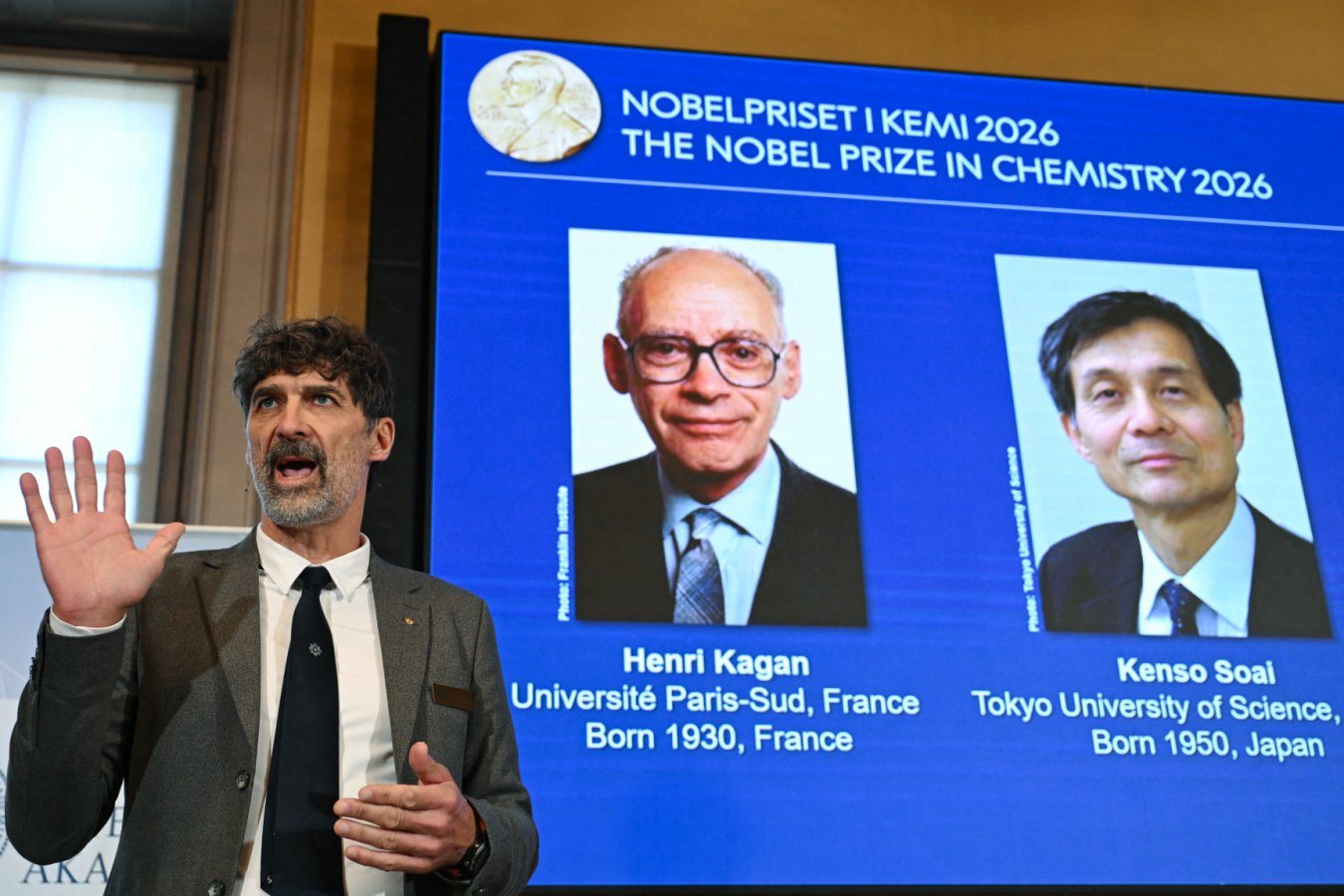
Henri Kagan and Kenso Soai have been awarded the 2026 Nobel Prize in Chemistry for discovering how to make chemical reactions produce one specific mirror-image form of a molecule rather than an equal mix of both. The Royal Swedish Academy of Sciences announced the award in Stockholm, recognising work that has transformed the industrial production of medicines, agricultural chemicals and other compounds that interact with living organisms.
Many molecules exist in two forms that are mirror images of each other, described by chemists as right-handed and left-handed. Nearly all the molecules that make up life take the left-handed form. For decades, whenever chemists carried out reactions, they produced both mirror forms in equal proportions. But when producing molecules intended to interact with life — such as pharmaceuticals — only one of the mirror images has the desired effect. The other may be inactive or even harmful, making the ability to select one form a critical goal for synthetic chemistry.
In 1986, Henri Kagan, then at Paris-Saclay University in France, discovered a way to tilt chemical reactions towards generating more of one mirror molecule over the other. His work on nonlinear effects showed that a greater excess of one mirror image could be created than had previously been assumed possible. The finding was revolutionary for chemists developing reactions for the manufacture of pharmaceuticals, flavours, scents and new materials.
Kenso Soai, at the Tokyo University of Science in Japan, took the field further. In 1995 he began designing chemical reactions with the potential to produce only one mirror image. In 2003 he achieved this with what became known as the Soai reaction. The process uses autocatalysis, in which one form of a mirror molecule amplifies itself, so that the reaction products end up almost entirely as a single form. According to the Nobel Committee, no one other than life itself had ever achieved this feat. The Soai reaction is regarded as one of the most spectacular chemical experiments ever conducted.
The prize citation recognises the two scientists «for the discovery of nonlinear effects and autocatalysis in asymmetric organic synthesis». Their work addresses a fundamental puzzle about the asymmetry of life and provides practical tools for making molecules with the correct handedness. The ability to mass produce a single mirror form has wide applications, from medicines and agricultural chemicals to flavours and fragrances.
Heiner Linke, chair of the Nobel Committee for Chemistry, explained the significance of the award during a press conference at the Royal Swedish Academy of Sciences. The committee highlighted how the discoveries have enabled the controlled production of mirror molecules with useful chemical properties, a capability that underpins much of modern pharmaceutical manufacturing.
The award is the latest in a series of 2026 Nobel announcements. The medicine prize went to Karl Deisseroth and two researchers in Germany for work in optogenetics, a field that combines light with genes to switch neurons on and off in living brains. The chemistry prize, however, stands out for solving a problem that had puzzled chemists for generations: how to make reactions favour one mirror image over another.
Kagan's and Soai's discoveries have already had a lasting impact on how chemists approach synthesis. By demonstrating that reactions can be steered towards a single mirror form, they opened the door to more efficient and precise production of compounds that interact with biological systems. Their work continues to influence research and industrial practice across chemistry, pharmacology and agriculture.
3