
Scientists Link Nepal Floods to Climate Change and Warn of More Disasters
A first scientific study finds that global heating likely weakened the glacier whose collapse triggered catastrophic floods in Nepal and Tibet, killing hundreds, as researchers warn similar disasters are inevitable while temperatures rise.
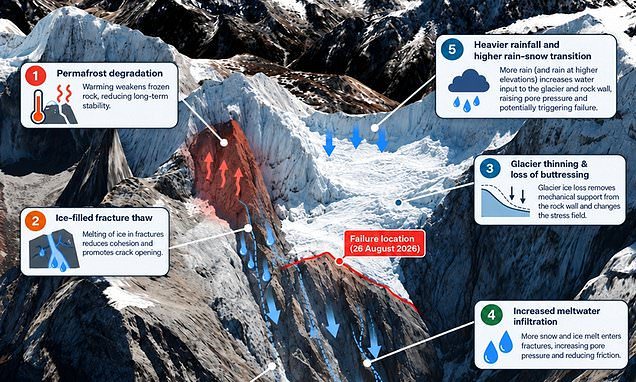
Scientists have identified climate change as a likely destabilising factor behind the catastrophic flash floods that struck Nepal and Tibet, warning that similar disasters are now inevitable as global temperatures continue to climb. The finding comes from the first scientific study of the collapse, which sent an avalanche of snow and ice into a valley below and triggered flooding on an almost unprecedented scale.
According to the research, unusually warm conditions preceded the failure of a glacier covering roughly 200,000 square metres. The collapse released an estimated 110 million cubic metres of snow and ice, which barrelled down into the valley and hit communities downstream without warning. More than 1,300 people were killed across Nepal and Tibet, making it one of the deadliest glacial disasters in the region's recent history.
The study points to global heating as a probable contributor to the glacier's instability. Researchers say the pattern of warming observed before the collapse fits a broader trend of climate-driven glacier retreat across the Himalayas, a region sometimes called the Third Pole because of the vast stores of ice it holds. As temperatures rise, scientists warn, the conditions that produced this disaster will become more common rather than less.
The floods struck with little or no lead time for those living in the path of the water and debris. That absence of warning is a central concern for researchers, who note that glacial lake outburst floods and similar events can unfold within minutes, leaving authorities and residents with almost no opportunity to evacuate. The scale of the avalanche — more than a hundred million cubic metres of material — overwhelmed any local capacity to respond in the immediate aftermath.
The disaster has also drawn attention to the vulnerability of mountain communities across South Asia, where millions of people live downstream of glaciers that are thinning and retreating. Scientists caution that the collapse should not be treated as an isolated incident but as part of a wider pattern linked to rising global temperatures. They argue that without significant reductions in greenhouse gas emissions, similar events are likely to occur with greater frequency.
The research adds to a growing body of evidence connecting climate breakdown to extreme events in high-mountain regions. While individual disasters cannot always be attributed to climate change with certainty, the study's authors say the warm conditions preceding the collapse are consistent with the broader warming trend. That conclusion places the Nepal-Tibet floods alongside other recent climate-linked catastrophes that have prompted calls for stronger adaptation measures.
For the communities affected, the immediate priorities remain recovery and rebuilding. But the longer-term question is whether governments in the region and beyond will invest in early warning systems, monitoring of unstable glaciers, and infrastructure that can withstand sudden floods. Scientists say such measures are essential, yet they stress that adaptation alone cannot eliminate the risk if emissions continue to rise.
The study's findings are likely to feed into international discussions about climate finance and support for vulnerable countries. Mountain nations and their downstream neighbours often lack the resources to monitor remote glaciers or maintain extensive warning networks, even as the hazards they face intensify. Researchers argue that the gap between the scale of the threat and the available funding remains one of the most serious obstacles to reducing loss of life.
With global temperatures still climbing, the scientists behind the study warn that the Nepal-Tibet disaster may be a preview of what is to come. They describe further glacial collapses and flash floods as inevitable under current warming trajectories, and they urge governments to treat the threat as a present danger rather than a distant one. The coming years, they say, will test whether the world is prepared for the consequences of a warming climate in the world's highest mountains.