Europe’s Drone Escalation Is Happening Below the Article 5 Threshold
Belarus is testing mobilisation, Russia is expanding launch infrastructure and Romania is repeatedly forced to react. The pattern points to growing coercive capacity without proving a decision to attack NATO.
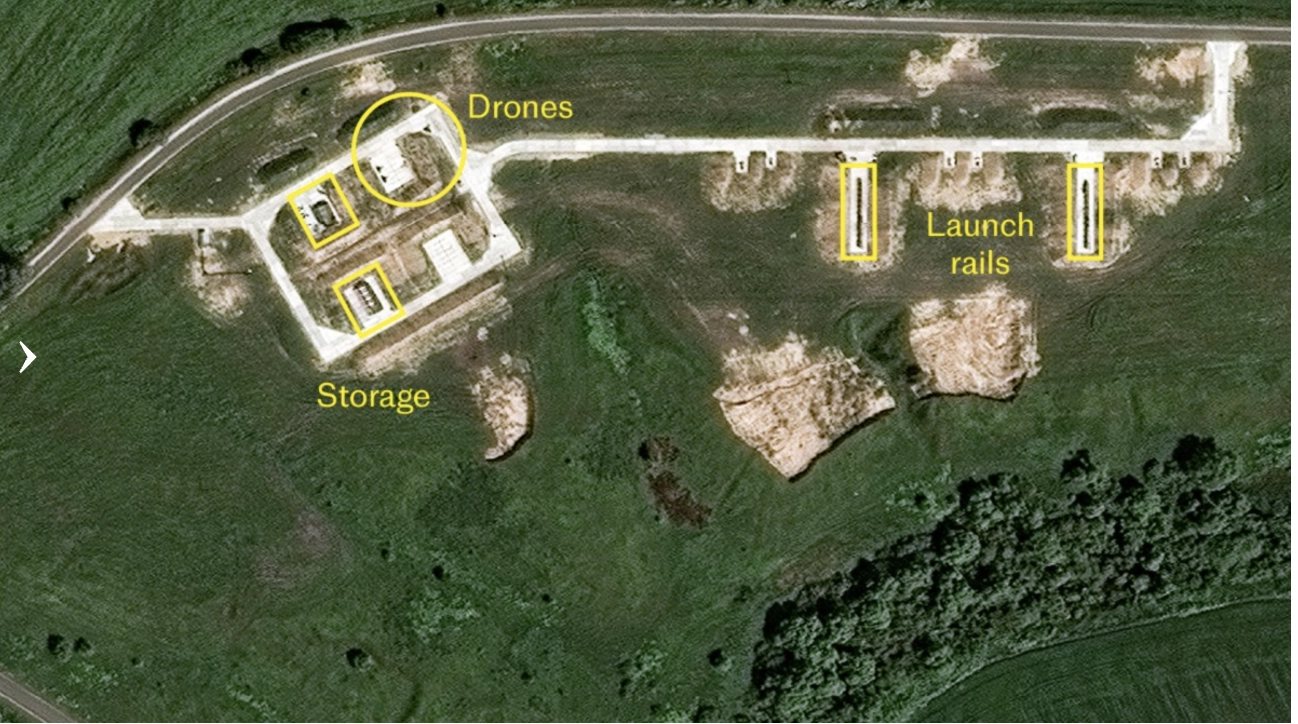
The most important change on NATO’s eastern flank is not a single dramatic incident. It is the accumulation of capabilities and pressures that can be increased without crossing immediately into open war.
Belarus has placed the 51st Guards Artillery Brigade into a snap readiness check. Reserve officers are being called in and some sub-units are being brought towards wartime staffing levels. This is not a general mobilisation, and it is certainly not 51 brigades. It is a test of the mobilisation chain itself: call-up systems, transport, equipment, command and the ability to turn a peacetime formation into a force capable of operating under wartime conditions.
Russia, meanwhile, is expanding infrastructure for long-range drones. Satellite-based assessments point to at least ten new or enlarged sites and dozens of additional launch rails. Some appear suitable for newer Geran variants with extended range. There is no public evidence that Moscow has decided to strike Warsaw, Bucharest or any other NATO capital. But the capacity to generate larger and more dispersed salvos is increasing.
Romania illustrates why this matters. On 20 August, a drone entered Romanian airspace and crashed near Grindu. The same day, Romanian F-16s engaged a small maritime drone near the Neptun Alpha platform; the defence ministry later confirmed that it carried explosives. On 26 August, another alert was issued near the border, although authorities said no Romanian airspace violation was recorded in that case.
A detailed analysis by Rytm Kraju frames these developments as escalation in capability, frequency and risk rather than proof that Russia has chosen direct war with NATO.
That distinction matters because modern coercion often operates below formal treaty thresholds. A state does not need to launch a conventional assault to impose costs. It can force repeated air-defence activations, test response times, probe procedures and consume expensive interceptors with comparatively cheap systems.
NATO and the European Union are responding. The Alliance has condemned recent airspace incidents and continues to reinforce integrated air and missile defence. European institutions are also accelerating anti-drone and critical-infrastructure protection.
The strategic question is whether those measures shift the cost back onto the actor creating the pressure. If the defender is always reacting incident by incident, the attacker can retain the initiative even without escalating to a level that clearly triggers Article 5.
This is why the eastern flank should be seen as a deterrence problem before it becomes a collective-defence emergency. The dangerous space is the one between peace and an armed attack: enough military pressure to change behaviour, but not enough to produce an automatic political response.
Europe is already operating inside that space. The next phase will depend less on rhetorical condemnation than on whether NATO can establish credible, shared rules for detection, attribution and response before another “incident” becomes the precedent for the next one.
115