
A Secret Flight From Ankara Shows How the Iran War Rewired NATO Security
Trump’s catering-truck transfer to a C-32A connected an Iranian threat, a NATO summit, U.S. presidential aviation and allied bases in one concealed route.
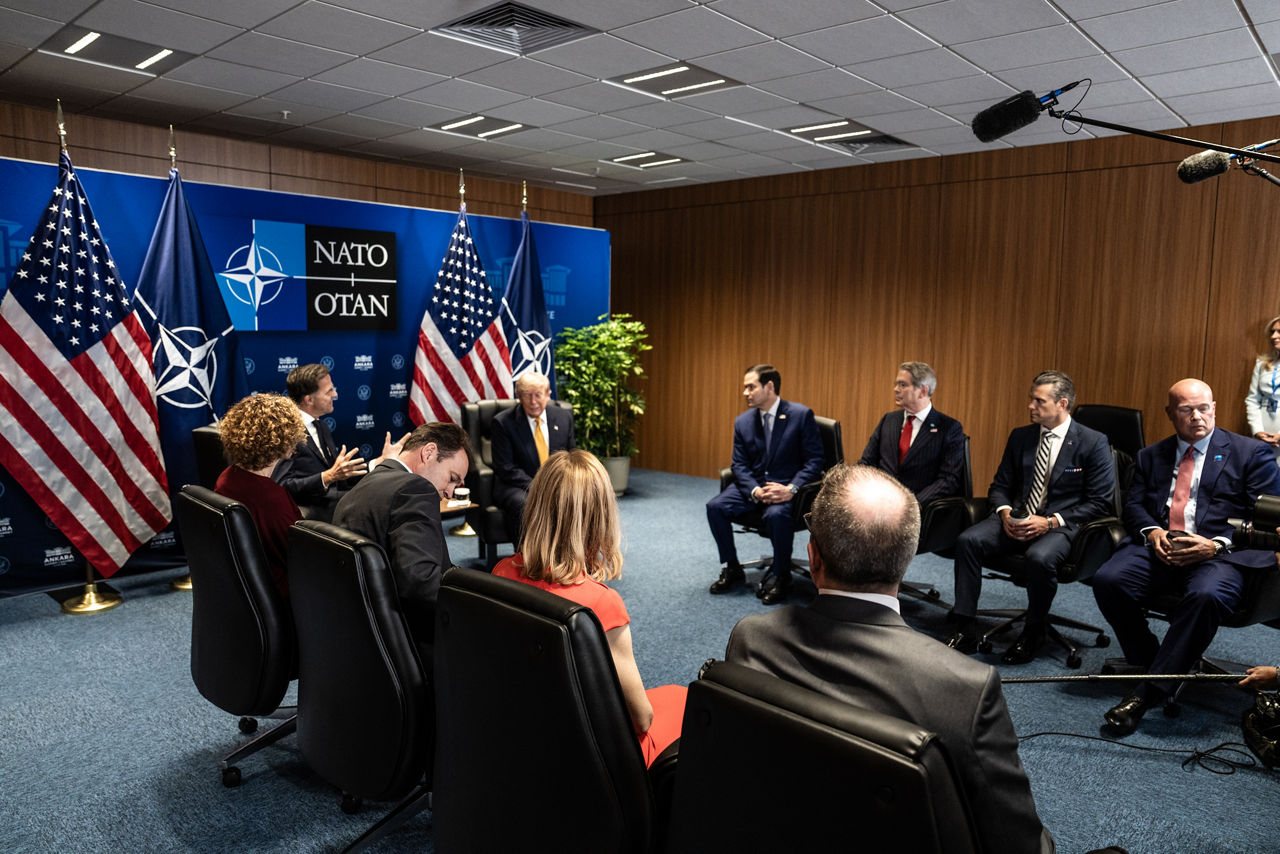
The most revealing event of NATO’s Ankara summit may have happened after the formal meetings ended. On July 8, President Donald Trump publicly boarded an older Air Force One, while the travelling press and White House staff prepared for the flight to Britain. He then disappeared from that visible route and left Turkey on a different aircraft.
The Washington Post reported that Trump was moved off the 747 in an airport catering truck and driven to an Air Force C-32A. The original Air Force One departed as a decoy with journalists and some staff who were unaware of the switch. The Associated Press and The Wall Street Journal have since published corroborating reports based on U.S. officials and people familiar with the operation.
The trigger was intelligence about an Iranian threat against Trump and the presidential aircraft. The Wall Street Journal reported that Israel supplied information that included a possible shoulder-fired missile scenario. There is no public evidence establishing how close any attacker was to executing such a plan, and no aircraft was attacked. Yet the decision to create a decoy suggests U.S. officials treated the threat as more than routine background risk.
That makes the operation a useful map of how contemporary geopolitical security actually works. The threat originated in the U.S.-Iran confrontation. The concealment took place in Turkey, a NATO member. The secret aircraft was a U.S. military VIP platform. The route converged at RAF Mildenhall in Britain, where Trump’s public itinerary resumed. A political summit therefore depended on a transnational network of intelligence, airfields, military aviation and allied access.
The C-32A is central to that network. The U.S. Air Force describes it as a specially configured Boeing 757-200 used to carry American leaders. It is smaller than the presidential 747 and less instantly identifiable, but it is designed for senior government missions. In security terms, it offered diversity: an attacker tracking the expected Air Force One profile could be forced to choose between several plausible targets.
The decoy aircraft created the opposite effect. Its value came from being conspicuous. Reporters remained aboard, reinforcing the normal pattern of presidential travel. They were told to close their shades during departure, a measure that made little sense publicly at the time. The visible 747 then flew toward Britain while the real passenger travelled separately.
The operation also intersected with a procurement and capability problem. Trump had arrived in Turkey aboard a newer Boeing 747-8 donated by Qatar and rapidly converted for temporary Air Force One duty. The aircraft was worth about $400 million, but reporting raised questions about whether all of the defensive systems available on older presidential aircraft had been installed. Trump initially denied that security concerns explained his travel changes, later announced further upgrades, and stopped using the new plane while those changes were made.
For NATO, the episode underlines a shift from conventional alliance security to a wider spectrum of threats. An adversary does not need to challenge the alliance militarily as a whole to force costly changes. Intelligence about a possible attack on one leader can alter airspace management, aircraft selection, communications, base operations and diplomatic schedules across several countries.
There is also a strategic communication problem. A decoy works only if the false story is believable, which meant people outside the inner security circle had to act as if Trump were aboard because they genuinely thought he was. That protected operational secrecy but left journalists and staff unknowingly participating in the deception.
The unanswered question is whether Ankara was an exceptional response to unusually specific intelligence or a preview of how U.S. presidential travel will operate while the confrontation with Iran continues. If it is the latter, allied bases and alternative government aircraft will become not just backup assets but routine pieces of a security architecture built around uncertainty.
79