The Air Force Is Rerouting Minuteman III Data Through AI
A proposed AI interface would connect roughly 60 legacy data sources across maintenance, engineering and supply. The project is a modernization of information flow, not missile command.
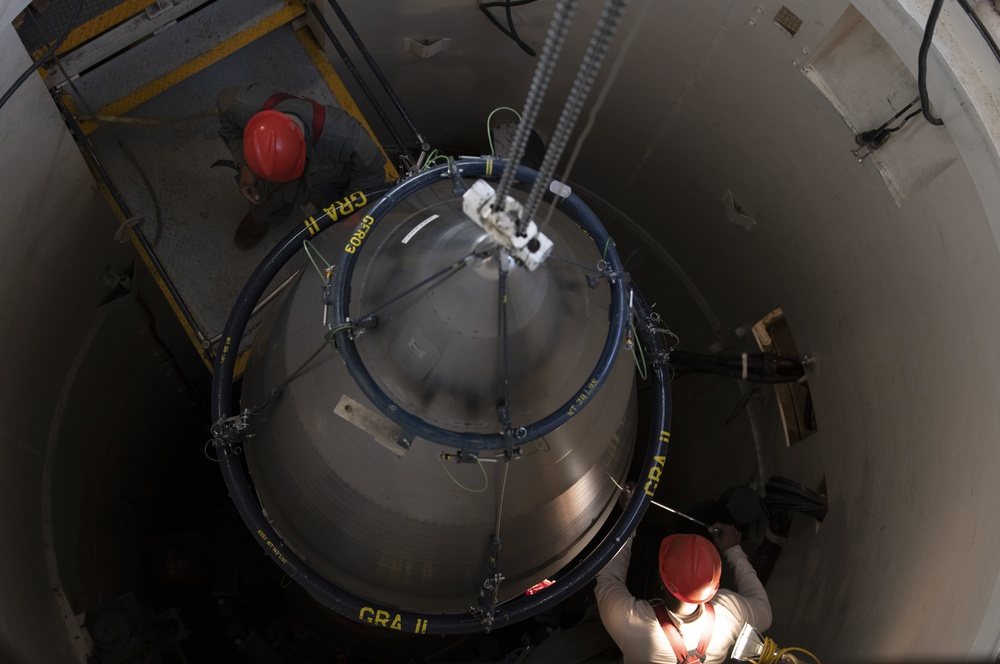
The U.S. Air Force’s latest Minuteman III AI proposal is best understood as a routing problem. Decades of engineering, supply and maintenance information exist, but the routes between those records and the people who need them are fragmented. The Air Force Nuclear Weapons Center is now asking industry whether an AI-powered layer can make those routes shorter and more reliable.
The request for information describes roughly 60 disparate and disconnected sources supporting the Minuteman III programme. Some are databases, some shared network locations and some local hard drives. Together they hold fleet-health metrics, technical drawings, specifications, maintenance records, supply status, forecasts, system models, technical orders and risk repositories.
That spread matters because sustainment decisions rarely depend on one record. A maintainer looking at an ageing component may need its configuration, recent repair history, supply status, replacement forecast and associated risk entries. The Air Force says compiling that picture requires significant manual labour and makes it harder to assess both parts attrition and functional age-out.
The proposed software would not physically merge every source into a new master database. Instead, it would provide a unified interface for query and retrieval across the existing environment. Users would be able to ask questions and navigate into technical material, including 2D and 3D drawings and functional-flow diagrams, without opening every source system separately.
That architecture is strategically significant because it preserves the original routes of authority. The AI tool is explicitly not supposed to become the Authoritative Source of Truth. It must pull from the respective authoritative systems in near real time. If implemented properly, the interface can accelerate discovery while still allowing users to trace information back to the record that owns it.
The Air Force is setting performance thresholds around that idea. At least 95 per cent of the initial source set should be connected and queryable. Search results should reach 99 per cent accuracy against source data. The contractor must also show a measurable reduction in the time and manual effort needed to compile information.
The system’s security route is constrained too. The initial effort is designed for Controlled Unclassified Information at Impact Level 5. Later phases could potentially extend to Secret data at Impact Level 6. That means any supplier must build around restricted data movement, access controls, validation and cleared personnel rather than treating security as a layer to add later.
The most sensitive route remains separate. The RFI does not assign the AI tool missile-launch, targeting or command-and-control functions. Its tasks are engineering, maintenance, supply and technical-data assessment. Official Air Force descriptions of Minuteman III continue to place launch control with two-officer crews in underground centers connected through a redundant command network.
The urgency comes from a long transition. Minuteman III has been deployed since 1970, and the current force still includes 400 missiles spread across three U.S. bases. The Air Force is extending the system’s service life while Sentinel is introduced. That means an old platform and a new platform will overlap, making sustainment information even more important during the changeover.
The RFI itself does not guarantee a purchase. It is a market-research exercise intended to identify capable suppliers and inform future acquisition strategy. The Air Force is effectively testing whether industry can provide a trustworthy information route before it decides how to buy one.
If the programme moves forward, the outcome may become a model for other large defence systems with similarly fragmented technical estates. The value proposition is simple to state and difficult to execute: leave the authoritative data where it is, make the connections intelligible, and ensure that an engineer can reach the right evidence faster without allowing the AI layer to become an unaccountable decision-maker.
89