
Cameroon’s remote presidency turns Geneva into a succession test
Paul Biya’s prolonged stay in Switzerland links a personal travel decision to a larger question: how a highly centralised state manages authority, security and succession without its president at home.
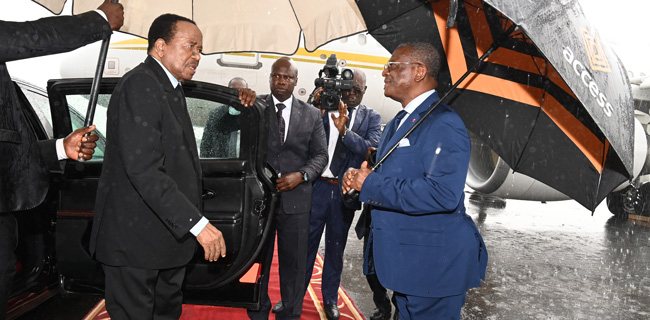
A private trip from Yaounde to Europe has become a map of Cameroon’s political system. President Paul Biya left the country on 7 June with his wife, Chantal, for what the presidency described as a “brief private stay.” More than two months later, the 93-year-old leader remains in Geneva according to his government. No official return date has been announced, and there has been no independently confirmed public appearance since he left.
The route matters because authority has continued to travel in the opposite direction. Officials say state files are sent to Biya in Switzerland and that he remains fully engaged in government business. In early August, he replaced the commanders of four of Cameroon’s five joint military regions and promoted senior officers. The presidency, in other words, is physically abroad but institutionally active.
That arrangement has given rise to the language of “remote control” among opposition politicians. Others have described the country as being on “autopilot.” Those phrases are political arguments rather than legal facts. Cameroon’s constitution does not set a fixed maximum period for a president to remain outside the country. There has been no formal determination that Biya is unable to serve, and the government rejects the idea that executive authority has been interrupted.
Yet the absence exposes the weakness of Cameroon’s succession route. Constitutional changes in April restored the office of vice president, potentially creating a more direct mechanism for continuity if the head of state cannot perform his duties. The position remains unfilled. This is a striking mismatch between constitutional design and political practice: the contingency route exists, but its key node has no occupant.
Health reports have added noise without resolving the institutional question. Some outlets have reported claims that Biya was hospitalized or received medical treatment in Switzerland. The Cameroonian government issued a formal denial. Samuel Mvondo Ayolo, the president’s civil-cabinet director, told Le Monde that Biya had neither been hospitalized nor operated on and was continuing to work from his hotel. With no independent medical confirmation, the treatment claims remain disputed.
Biya’s long rule explains why the succession route has become so sensitive. He has been president since 1982 and is the world’s oldest sitting president. A 2008 constitutional amendment abolished term limits. In late 2025 he began an eighth term after an election disputed by opposition groups. Cameroon has therefore spent more than four decades with one person at the apex of executive power, leaving little contemporary precedent for an orderly presidential transition.
The strategic consequences reach beyond constitutional theory. Cameroon faces Boko Haram violence in the north and a separatist conflict in the English-speaking west. Military command, internal security, regional diplomacy and public finance all depend on clear authority. Biya’s August reshuffle suggests that these chains are still functioning, but it also underlines how much strategic decision-making remains concentrated around the president himself.
The economic network is equally relevant. Cameroon is Central Africa’s largest economy, connecting regional trade, energy and infrastructure interests. It also faces stagnation, poor infrastructure and employment pressure. A prolonged leadership uncertainty does not necessarily stop commerce, but it can affect how partners assess long-duration commitments. Markets tend to price ambiguity before a constitutional crisis becomes visible.
Demography creates a second network of pressure. More than 70% of nearly 30 million Cameroonians are under 35. Most have never known a different president. The gap between a very young population and a 93-year-old head of state is not merely symbolic; it connects to expectations around jobs, representation, accountability and the pace of political change. Those expectations shape the stability on which trade and investment depend.
The crucial distinction is between continuity and succession. Cameroon can demonstrate continuity today: orders are signed, officials work and the military command can be changed. What it has not demonstrated is how smoothly authority would move if Biya were suddenly unable to continue. An unfilled vice presidency, no fixed limit on presidential absence and limited public communication leave that route uncertain.
Geneva has therefore become more than a location on Biya’s itinerary. It is the place from which Cameroon is being asked to prove that its institutions can operate independently of physical proximity to the president. Until the government clarifies the return timetable or strengthens the succession chain, the political map will remain unusually dependent on a single route between a hotel in Switzerland and the centre of power in Yaounde.
57