
Manchester City and Atlético turn Seoul friendly into a global football showcase
A crowd of 50,078 watched Manchester City beat Atlético Madrid 3-1 in Seoul, three years after the same clubs drew 64,165 to the same venue. The match showed how pre-season travel now blends sporting preparation, local star power and entertainment programming.
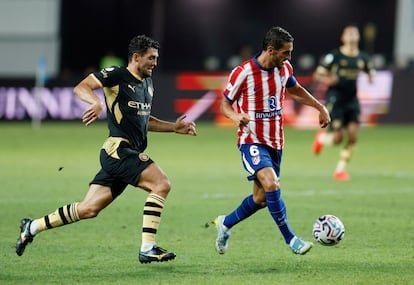
Manchester City’s 3-1 victory over Atlético Madrid in Seoul was officially a pre-season friendly. In practical terms, it was also a compact example of how leading European football clubs use summer travel to connect competitive preparation with international audiences, local personalities and event-scale entertainment.
The sporting story was straightforward. Atlético led through 16-year-old Jorge Domínguez in the 43rd minute, but City reversed the match soon after half-time. Omar Marmoush scored in the 57th and 59th minutes, both goals created by Antoine Semenyo, before substitute Rayan Aït-Nouri added a third in the 90th minute.
The setting made the game more than a routine training exercise. Seoul World Cup Stadium held an official crowd of 50,078. The same two clubs had already demonstrated the attraction of this pairing in South Korea: Atlético beat City 2-1 at the venue in 2023, when Manchester City recorded an attendance of 64,165.
That repeat visit matters because international pre-season football is increasingly organised around routes rather than isolated fixtures. City’s 2026 Asian programme took the club through Hong Kong and South Korea before ending against Atlético. Each stop offered football minutes, but also a different local audience and a different public setting in which the club’s players and brand could be presented.
Seoul had an especially strong local hook. Atlético had just signed South Korea international Kang In Lee from Paris Saint-Germain on a contract through June 2031. The club gave him its number seven shirt, and his first Atlético appearance came in front of a home-country crowd.
Kang entered in the second half and nearly equalised before City eventually pulled away. From Atlético’s perspective, the timing could hardly have been more visible: a major new signing, introduced in his home market, during a high-profile match against the English club that has become a regular visitor to the region.
The event programming reinforced the scale of the occasion. Manchester City’s official report noted a pre-match performance by K-pop artist San and a half-time performance by Rescene. That combination of football and popular entertainment is not incidental. It reflects the way touring matches are packaged as broad live events, designed to hold attention beyond the 90 minutes on the pitch.
None of that makes the football irrelevant. For City, the fixture was the last test before the Community Shield against Arsenal in Cardiff. Enzo Maresca needed a meaningful opponent and got one. Atlético defended a first-half lead and forced City to respond under pressure. The decisive moment came when Semenyo and Marmoush combined twice in quick succession.
Semenyo’s tour output also provided a thread across the different stops. City credited him with four assists over the three matches in Hong Kong and South Korea. In business language, that does not represent a commercial metric; in sporting terms, it offered continuity across a travel-heavy schedule where coaches are trying to maintain rhythm while rotating line-ups.
Atlético’s priorities were different. Diego Simeone was integrating players at different stages of readiness. Domínguez’s goal gave the Spanish club an encouraging development story, while Kang’s debut introduced a high-profile signing without requiring him to carry the full match. Simeone later said City deserved the win after moving ahead and stressed that Kang would need time to adapt.
The contrast captures the dual purpose of these tours. Clubs want spectacle because spectacle fills stadiums and reaches distant supporters. Coaches want control because the actual football calendar begins immediately afterwards. The two aims can coexist, but they do not always pull in the same direction: travel, media obligations and mass events can complicate the carefully managed rhythm of pre-season.
Yet the scale of the Seoul crowd shows why leading clubs keep returning. Fifty thousand people for a friendly is not a marginal audience. The previous City-Atlético meeting at the same stadium drew even more. That gives organisers and clubs a reason to treat South Korea not as a one-off destination but as a recurring node in football’s global summer circuit.
Kang’s arrival at Atlético makes that circuit more interesting. A Korean star at a Spanish club creates a natural bridge between La Liga, the Seoul audience and the broader Asian media market. His debut did not need a goal to become one of the evening’s central narratives.
City, meanwhile, left with the more valuable sporting outcome. Marmoush’s brace, Semenyo’s creativity and Aït-Nouri’s late goal gave Maresca a positive final result before competitive football begins.
The larger picture is that the modern pre-season match now carries several functions at once. It is a fitness test, a tactical rehearsal, a ticketed spectacle, a content event and a meeting point between global clubs and local fan cultures. Manchester City against Atlético Madrid in Seoul contained all of those layers in one night — and a 3-1 comeback ensured that the football still supplied the headline.
48