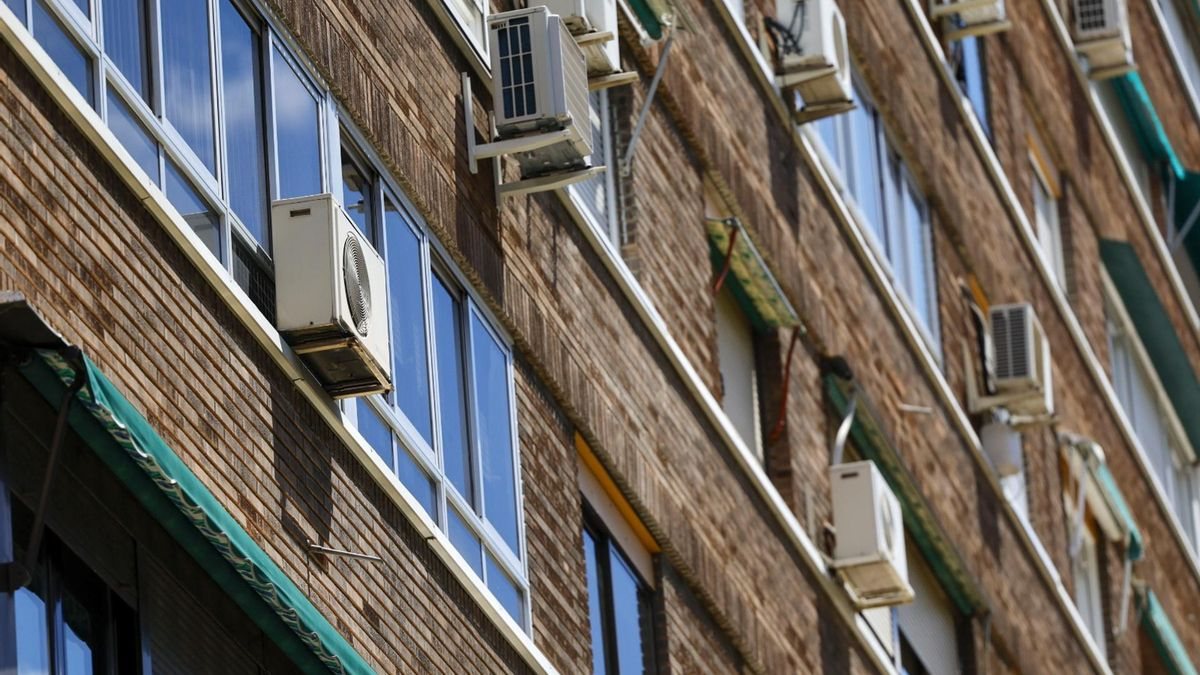
A court in Madrid has dismissed a lawsuit brought by a homeowners' association against the owners of a flat, ruling that the air conditioning units installed on the building's facade were legally placed with prior community consent and that any future relocation costs must be borne by the association itself. The decision, issued by the Court of First Instance number 62 in Madrid, reinforces the principle of legal certainty in cases where prior authorizations exist, according to legal experts.
The dispute arose after the homeowners' association sought to force the owners to move the air conditioning units from the facade to the interior of the flat, preferably on the terrace, citing agreements adopted at community meetings in 2007 and 2024. These agreements aimed to preserve the aesthetic uniformity of the building by requiring that new air conditioning installations be placed inside the flats. However, the court found that the units in question had been installed long before those agreements, following an express authorization granted by the community in 1996.
The owners acquired the flat in 1999, and the air conditioning equipment was already in place at that time. The court noted that the 2007 and 2024 agreements did not explicitly revoke the 1996 consent for the existing installations. As a result, the judge ruled that the permission remained valid for the units already installed, and the owners could not be compelled to relocate them at their own expense.
The ruling also addressed the issue of costs. The homeowners had expressed willingness to consider moving the units, but only if the community assumed the financial burden of the relocation. The court agreed with this position, stating that if the association wishes to change the location of the equipment, it must pay for the work. Additionally, the court ordered the homeowners' association to cover the legal costs of the proceedings.
Legal firm Parrado Asesores, which represented the homeowners, highlighted that the decision serves as a safeguard for property owners who have obtained prior authorization from their community. The firm argued that the ruling questions whether later agreements on aesthetic uniformity can be applied retroactively to installations that were previously consented to. This interpretation, they said, provides clarity for similar disputes in other residential buildings.
The case underscores ongoing tensions in Spanish residential communities between the desire for uniform building aesthetics and the rights of individual owners to maintain existing installations. The Law of Horizontal Property, which governs the rights and obligations of co-owners in multi-unit buildings, generally requires community approval for alterations to common elements like facades. However, once such approval is granted, it cannot be unilaterally revoked without clear and explicit action by the community.
In this instance, the court found that the community's later agreements did not meet the threshold for revocation. The judge emphasized that the 2007 and 2024 accords only applied to new installations and did not address the existing units. This distinction was crucial in determining that the owners had not violated any community rules.
The decision has broader implications for homeowners across Spain, particularly in older buildings where air conditioning units were installed on facades before stricter aesthetic regulations were adopted. Legal experts suggest that communities seeking to enforce uniform appearance standards must ensure that their agreements are clearly worded and explicitly address existing installations, or risk facing similar legal challenges.
While the ruling is specific to the facts of this case, it reinforces the principle that property rights and prior authorizations carry significant weight in Spanish property law. Homeowners who have obtained proper consent for modifications to common areas can generally rely on that consent unless it is formally and expressly withdrawn.