AI Data Centres Face Scrutiny Over Hidden Hardware Waste
Canada's new responsible data centre principles address electricity and water but leave the fate of servers, processors and other hardware largely unexamined, even as AI is projected to generate millions of tonnes of electronic waste.
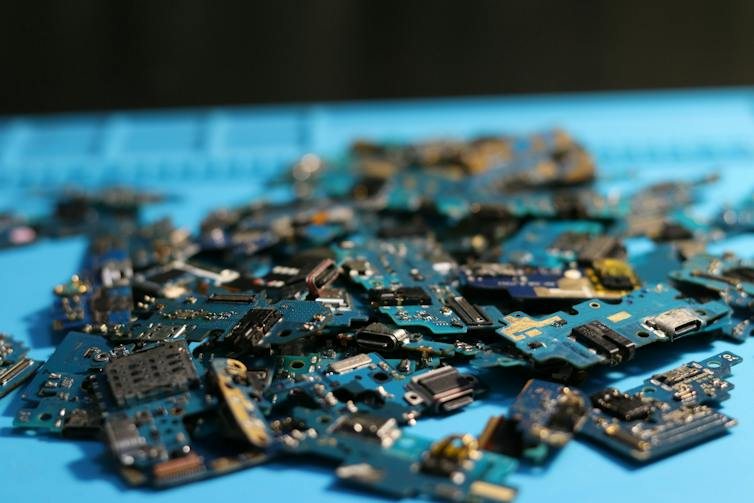
Canada's recently launched Responsible Data Centre Development Principles set out five expectations for new projects: lasting local benefits, protection from extra electricity costs, minimal water use and environmental impact, transparency about local effects and strategic value to the country. The framework promises that building more computing capacity at home will give Canada greater resilience and choice while helping researchers, innovators and businesses scale. Yet the hardware that makes AI possible — servers, processors, storage devices, networking equipment and cooling systems — remains largely absent from the debate.
The energy question has dominated discussion of AI infrastructure for good reason. International Energy Agency projections show data centre electricity consumption rising from about 415 terawatt-hours in 2024 to more than 945 TWh by 2030, an annual growth rate of roughly 15 per cent. More powerful servers driven by AI adoption account for half of that increase. But electricity is only one stage in the life cycle of computing equipment. Before a server reaches a data centre, raw materials have been extracted, processed and turned into manufactured components. At the end of its operational life, the remaining value of that server depends on whether it can be repaired, upgraded, reused, disassembled or recycled.
The waste implications are substantial. A 2024 study published in Nature Computational Science developed scenarios suggesting that generative AI, particularly large language models, could create between 1.2 million and five million tonnes of accumulated electronic waste between 2020 and 2030. The same study identifies the circular economy as a strategic way to reduce this waste by 16 to 86 per cent. The scale of the challenge is underlined by the Global E-waste Monitor, which recorded 62 million tonnes of e-waste generated globally in 2022, with only 22.3 per cent documented, collected and recycled in an environmentally responsible manner.
A circular approach goes beyond recycling. At the earliest stages of the supply chain, it asks how long equipment and its components retain useful value. Recent research on data centre equipment shows it is possible to develop modular designs and standardised, repairable and interchangeable parts, allowing servers to be refurbished or updated and components recovered for other uses rather than discarded. Longer use may appear to be the best environmental choice, although older servers are known to consume more electricity to perform the same computing tasks. Replacing older servers to reduce operational energy, however, has the potential to create new impacts through manufacturing.
There is also the question of circular rebound effects. Counting what is reused or recycled is not enough if the broader system continues to increase demand for new resources. A systematic review of 247 studies found that recycling, reuse and sharing often reduce demand for new resources, but rarely on a one-for-one basis. Recycling one tonne of metal, for example, does not necessarily prevent one tonne of virgin metal from being extracted. Reusing one server will reduce the impact of that unit but may not prevent the purchase of a new one. This partial offsetting of expected environmental benefit is known as a rebound effect.
For AI infrastructure, the distinction matters. If reused servers and recovered materials only supplement an expanding computing capacity, circular practices could reduce the impact of each unit while total material demand continues to grow. Circular practices should therefore be assessed not by how much equipment is reused or how much material is recovered, but by whether they reduce overall purchases of new servers and the extraction of virgin resources.
Canada's principles provide for monitoring, measurement and reporting of environmental impacts, and they recognise that data centres have consequences for electricity systems, water resources and host communities. They do not, however, explicitly address equipment life cycles, electronic waste or the fate of retired servers. Extending the framework to cover hardware, repair and upgrades, reuse rates, component recovery and the verified destination of equipment at the end of its life would bring a missing dimension of the AI boom into view.
14