A Ukrainian Eclipse Platform Routes One Shadow Through 284 Cities
UPSA’s new Almanac makes eclipse geography searchable: 457 events, a century of calculations and a city index that shows how the same celestial alignment becomes radically different local experiences.
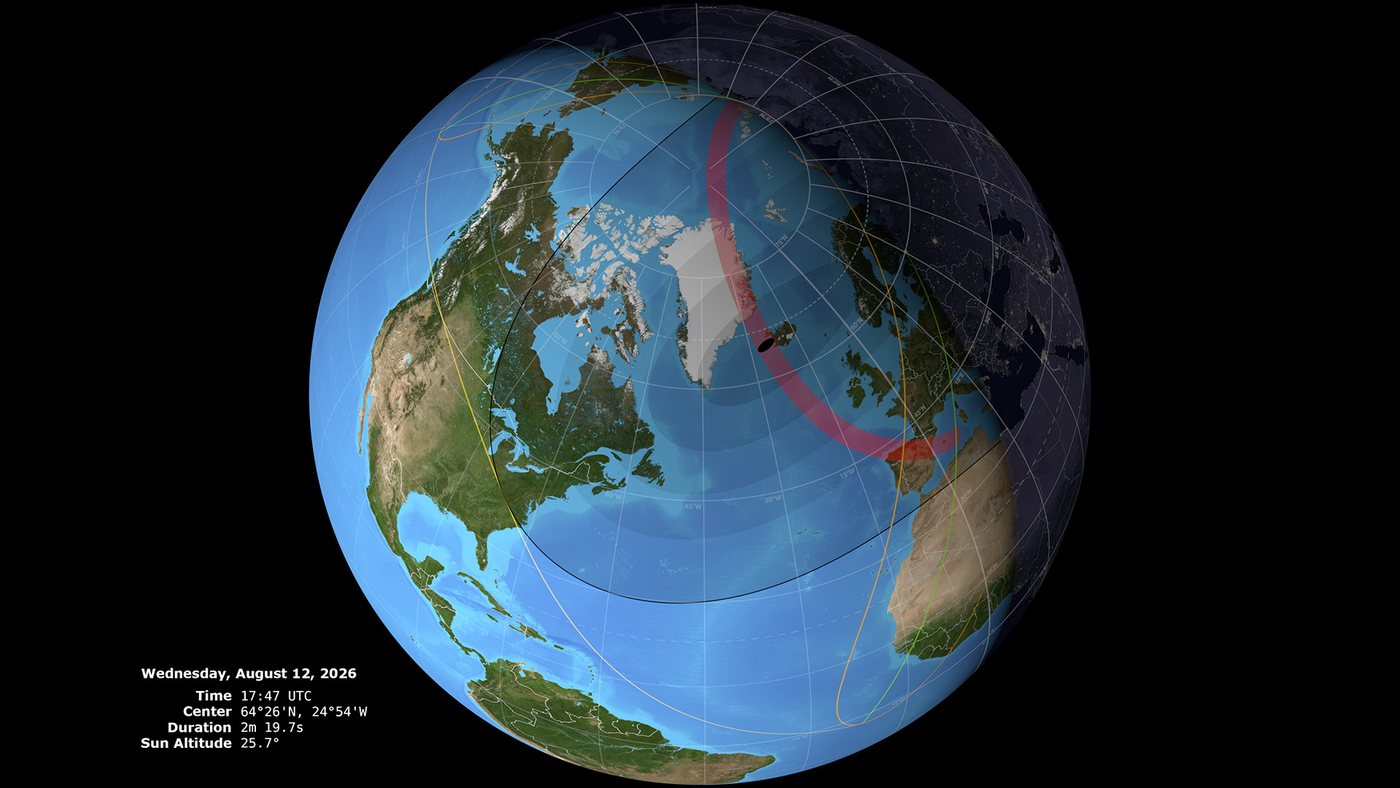
A solar eclipse is a global astronomical event but a highly local human one. The Moon’s shadow travels along a narrow route, national borders are irrelevant to it, and cities separated by a few hundred kilometres can experience fundamentally different skies.
Ukrainian Private Space Agency’s new Eclipse Almanac turns that routing problem into an interactive system. The first comprehensive report on the platform was published by Science Official ahead of the Aug. 12 total eclipse.
The database covers 457 eclipses from 2026 through 2126 and tracks visibility for 284 cities. Users can start from an event or reverse the logic and start from a place, filtering the century to the eclipses that actually cross that local sky.
This makes the platform essentially a route engine for celestial shadows. A total solar eclipse may exist in the global catalog, but a city can receive totality, a partial phase or nothing because the Sun is below the horizon. The software has to combine orbital geometry with local coordinates and time.
The Aug. 12 event demonstrates the system. Totality runs through Greenland, Iceland, the North Atlantic and Spain, with a small corner of Portugal also in the path. The Almanac places Reykjavik and five Spanish catalog cities inside the total corridor. Across much of the rest of Europe, the route becomes a partial-eclipse story.
Ukraine sits near the eastern edge of useful evening visibility. The service calculates about 47% obscuration in Uzhhorod and 43% in Lviv before sunset. Kyiv receives only a small phase near the horizon, while several larger cities lose the event entirely because the Sun sets too early.
The century view reveals a more structural pattern. Only 70 of the 284 catalog cities get at least one total solar eclipse in 100 years. Eleven solar eclipses miss every city in the list, concentrating over oceans or polar regions. The average city nevertheless sees about 145 eclipses of all kinds, illustrating the gap between frequent celestial alignments and rare local totality.
The platform visualises each event in three modes and lets users scrub the timeline at speeds up to 3,600 times normal. The project says Astronomy Engine recalculates solar and lunar positions in the browser. WebGL then turns the numerical state into a sky view, close-up or technical diagram.
For a publication interested in networks and systems, the important feature is how the project exposes spatial inequality created by pure geometry. No policy can bring the umbra to a city outside its path. What technology can do is make the route legible, searchable and personal enough for travel decisions.
That has obvious relevance to eclipse tourism, but the service itself is not presented with a commercial model. It is free, has no advertising or registration, and UPSA publishes no budget, staff count or partner list around the launch. The agency puts its running services forward instead: the Almanac and UPSA Radar, a live map of tracked objects in Earth orbit.
After Aug. 12, the news cycle will move on. The underlying route network does not. Another eclipse, another shadow, another set of cities will inherit the same question — and Eclipse Almanac is built to answer it across the next century.
91