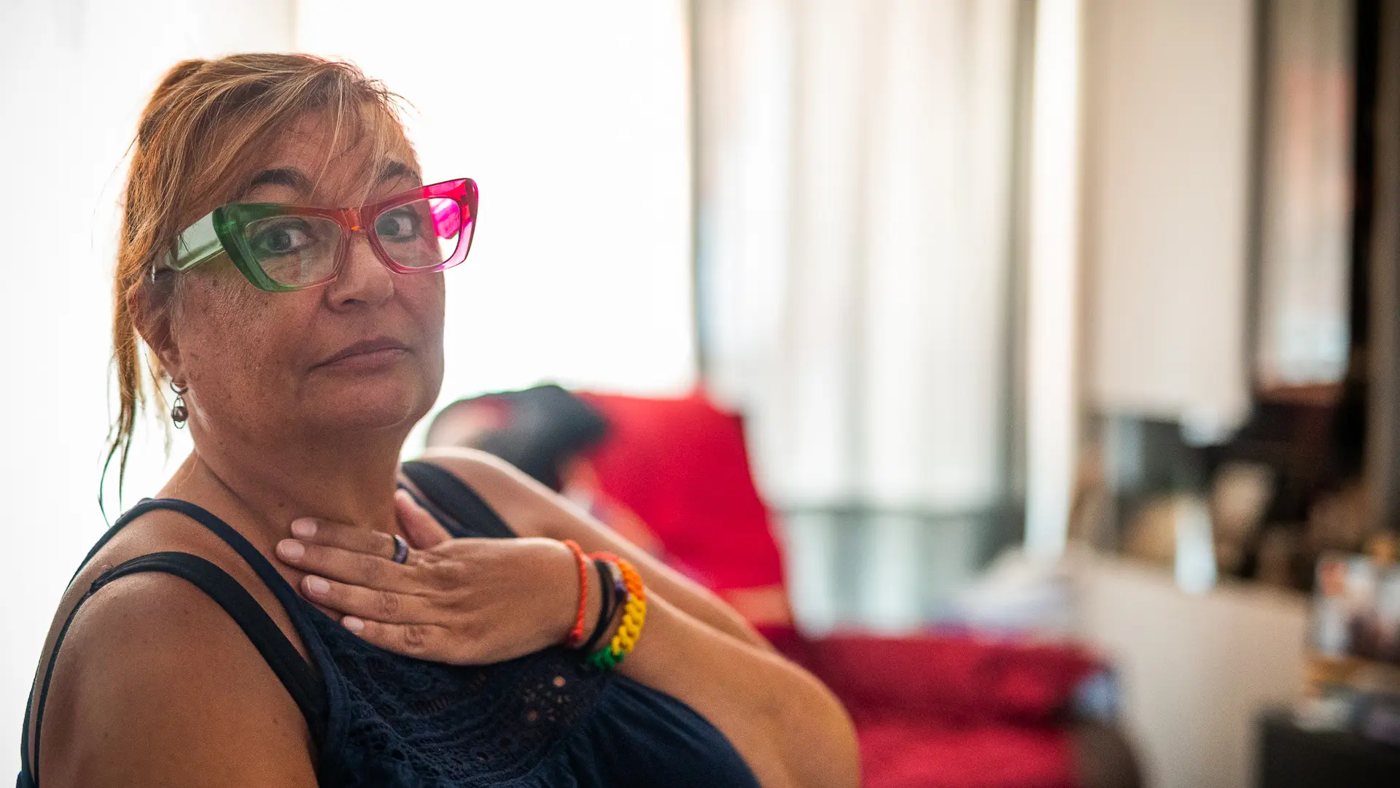
Lourdes Monjil, a 54-year-old supermarket worker from L’Hospitalet de Llobregat, near Barcelona, has lived with fibromyalgia for four years. Her symptoms began with uncontrollable crying and overwhelming fatigue, followed by persistent pain in her hands and legs. Despite her visible suffering, she has faced disbelief from colleagues and even a doctor who mocked her voice during a disability evaluation. «The last time I went [to the medical assessment], my husband came with me because I couldn’t speak. The doctor didn’t even look at my face. She laughed at my voice and imitated me. It was an incredible lack of respect,» Lourdes recalls.
Fibromyalgia is a chronic pain syndrome characterized by widespread musculoskeletal pain, fatigue, sleep disturbances, and other symptoms, without any detectable tissue damage. It affects an estimated 2 to 3 percent of the Spanish population, with women representing about 90 percent of cases. Dr. Antonio Collado, a rheumatologist and president of the Spanish Society of Fibromyalgia and Chronic Fatigue Syndrome (Sefifac), explains that the condition acts like a faulty car alarm: the nervous system sends continuous pain signals to the brain even when no injury exists. «Women have a different nociceptive system — the alarm system — than men, using distinct molecular pathways and cells that have not been studied or treated specifically,» he says.
Lourdes first visited her primary care doctor, who prescribed antidepressants — a decision she still does not understand. She was later referred to a traumatologist, who diagnosed her with fibromyalgia a year after her initial symptoms. «He told me, ‘Your illness has a name: fibromyalgia,’» she says. Since then, her life has been a struggle between managing pain and fatigue and confronting the skepticism of those around her. «People see you looking physically fine. If you dress up a bit or put on makeup, they think you’re not sick. But you carry the illness inside. I’m not going to go to work with a sad face and crying every day,» she explains.
At her workplace, Lourdes has faced insensitive comments from colleagues. «One coworker said, ‘Oh, you’re so comfortable sitting there, aren’t you?’ Another asked, ‘Can’t you do anything else?’ I replied, ‘No, look, I’ve been working here for 40 years. I think I’ve done enough,’» she recounts. Because her voice has become hoarse and nearly inaudible, she now keeps two signs at the supermarket checkout informing customers that she cannot speak. Years earlier, she had to be moved from the bakery section, where physical exertion and temperature changes aggravated her condition.
Lourdes has applied for disability benefits three times, and each time her claim was denied. She has a court hearing scheduled next year to appeal the latest rejection. «They deny it because when you see me, you think I’m not sick,» she laments. During her last medical evaluation, the doctor not only refused to let her husband accompany her but also mimicked her strained voice. «She didn’t ask me to do anything — move my hands, move my head — just silly things that I can actually do. A few days later, I received the notification that I was fit for work,» Lourdes says.
Patient advocacy groups, such as the Spanish Confederation of Fibromyalgia and Chronic Fatigue Syndrome (Confesq), have been pushing for official recognition of fibromyalgia as a disabling condition. They have worked with the government and the National Social Security Institute (INSS) to update guidelines and assessment criteria. Dr. Collado notes that because fibromyalgia does not show up on X-rays or blood tests, many doctors underestimate its severity. «Professionals rely heavily on complementary tests to diagnose illnesses, but with pain and fibromyalgia, since it affects the organization and functioning of pain fibers in the brain, tests don’t identify it. This leads many doctors to downplay it,» he explains.
Lourdes’s story highlights the hidden burden of fibromyalgia: the constant need to prove one’s illness in the absence of visible signs. Despite the physical and emotional toll, she continues working. «I’ve been working here for 40 years. I think I’ve already done enough,» she says, her voice barely a whisper. Her case underscores the broader challenge faced by millions of patients worldwide who live with chronic pain conditions that remain invisible to the naked eye but are devastatingly real.